How to Play Pyramid Solitaire
Learn pyramid solitaire from scratch: which cards pair, when a card is free to take, how the stock works and how the pyramid is cleared.
Rules checked against the engine that runs the board on .
 Play Pyramid Solitaire now Free, in this tab, no sign-up
 How to play Pyramid Solitaire, step by step
-
Look at the pyramid
Pyramid solitaire is played with one 52-card pack. Twenty-eight of the cards are dealt face up in a pyramid of seven rows — one card at the top, then two, then three, down to seven along the bottom — with each card overlapping the two beneath it. The other twenty-four cards form the stock, the face-down pile beside the pyramid, and the space next to the stock, where turned cards land face up, is the waste.
-
Learn what the cards are worth
Every card in pyramid solitaire has a value: an Ace is 1, the number cards are worth their number, a Jack is 11, a Queen is 12 and a King is 13. Suits and colours do not matter anywhere in this game — a heart is worth exactly what a spade of the same rank is worth. Those values are the whole game, because every move you make is about adding two of them together.
-
Remove pairs that add up to thirteen
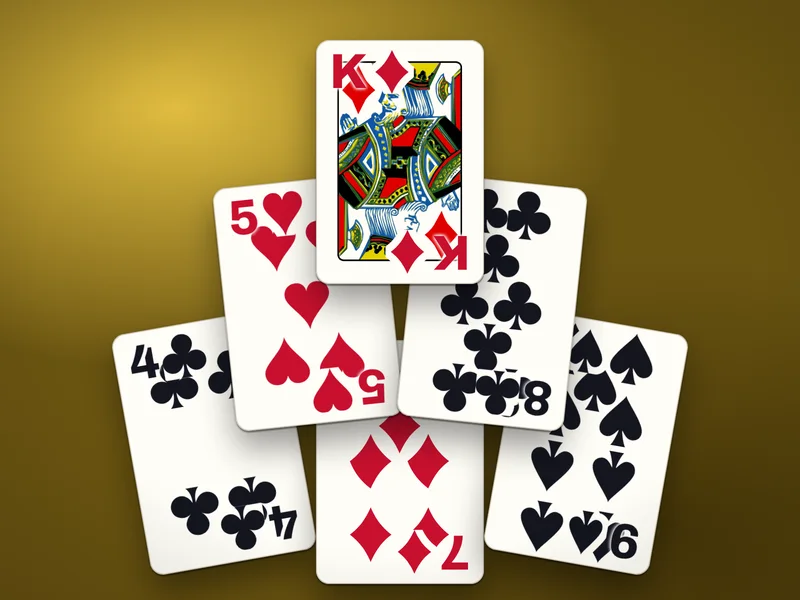
Two cards can be taken off the table together if their values add up to thirteen: Queen with Ace, Jack with two, ten with three, nine with four, eight with five, and seven with six. Tap one card and then tap its partner, and both are gone for good. A King is worth thirteen on its own, so a King is removed by itself with a single tap — it never needs a partner.
-
Know which cards you are allowed to take
A card in the pyramid can only be taken when nothing is resting on it, which means both of the cards overlapping it from the row below have already gone. So the seven cards along the bottom row are available immediately, and the single card at the top of the pyramid is the last one you can reach. The top card of the stock and the top card of the waste are always available, and they can even be paired with each other.
-
Turn the stock when nothing on the table pairs
Click or tap the stock and its top card is turned face up onto the waste. That card is now available to pair with any uncovered pyramid card, or with the next card off the stock. Only the top card of the waste is in play — the ones underneath are out of reach until the stock is turned over. Turning a card is free, but there are only twenty-four cards in the stock, so what you spend them on matters.
-
Go through the stock again, twice
When the stock is empty you may turn the waste over, unshuffled, and run through the same cards again in the same order. This game allows two of those redeals by default, so you see the stock three times in all, and the control above the table can set it to one or none if you want a harder game. Each setting keeps its own record, because a win with no redeals is not the same as a win with two.
-
Clear the pyramid to win
The game is won the moment the last card leaves the pyramid, whatever is still sitting in the stock or the waste — you do not have to clear those. It is lost when no two available cards add to thirteen, no King is showing, and there is no card left to turn or redeal that could change that. Undo takes back any move, and Hint will point at a legal pair if one exists.
Play Pyramid Solitaire That is enough to start. The rest of this page is the reference.
The rules in full
Everything the Pyramid Solitaire lesson above skipped: the edge cases, what happens when you run out of moves, how the game ends and how it is scored. 7 sections, written to be looked things up in rather than read straight through — the contents at the top of the page jump to any of them.
The words on the table
- Pyramid
- The twenty-eight cards dealt face up in seven rows. Clearing it is the win.
- Covered
- A card with one or two cards from the row below still resting on it. A covered card cannot be taken, whatever it is worth.
- Available
- A card nothing is resting on. That means any uncovered pyramid card, the top card of the stock and the top card of the waste.
- Stock
- The twenty-four cards not dealt into the pyramid, face down. Turning it moves one card to the waste.
- Waste
- The face-up pile beside the stock. Only its top card is in play.
- Redeal
- Turning the emptied waste back over to become the stock again — same cards, same order, nothing shuffled.
The deal
Twenty-eight cards go out face up in seven rows: one, two, three, four, five, six, seven. Each card in a row sits across the two cards below it, so the pyramid is a wall of overlaps and the only cards you can reach at the start are the seven along the bottom edge. The remaining twenty-four cards are the stock.
Every legal move
- Take a King. A King is worth thirteen on its own. If it is available, one tap removes it.
- Take a pair worth thirteen. Queen and Ace, Jack and two, ten and three, nine and four, eight and five, seven and six. Both cards must be available. They can come from anywhere available: two pyramid cards, a pyramid card and the waste, a pyramid card and the stock, or the stock and the waste together.
- Turn a card from the stock onto the waste. One card per tap.
- Redeal, when the stock is empty and redeals remain: the waste turns back over, in the same order, and becomes the stock again.
There is no way to put a card back into the pyramid, no way to reach the second card of the waste, and no move that is legal for a covered card. That is the whole game — which is why the thinking is all about which card unlocks which.
How a game ends
You win when the pyramid is empty. Cards still sitting in the stock or waste do not matter.
You lose when no two available cards make thirteen, no King is available, and there is nothing left that could change that — no card in the stock to turn, and no redeal that would bring more than one card back into play. The board works that out for you and says so, rather than leaving you clicking at a dead position. Before that point, Hint will show a legal pair if one exists, and Undo steps back through the last three hundred moves, one at a time, with no penalty for using it.
How the score works
Five points for each card removed, so a King alone is worth 5 and a pair is worth 10. On top of that, clearing a whole row of the pyramid pays a bonus, and because a row can only be emptied after the row beneath it, the bonuses arrive from the bottom up and get larger: 25 for the seven-card bottom row, then 50, 75, 100, 125, 150, and 175 for the single card at the apex.
Clear everything — all fifty-two cards, every row — and the score is 960. That is the ceiling, and it is the only number this game can show that is worth chasing for its own sake. The clock beside it is a plain timer, and each redeal setting keeps its own three records: best score, fastest win and fewest moves.
Where this game makes a choice
Pyramid is published in more variations than almost any other patience game, so here is what this one does.
- Two redeals by default, adjustable to one or none. Pagat records versions with no redeal, with two, and with unlimited passes; two is the common compromise and the setting most people mean.
- The redeal does not shuffle. The waste turns over as it lies, so the order is predictable and remembering it is a genuine skill.
- The stock card and the waste card may be paired with each other. Some versions forbid it. Ours allows it, which is the more common rule.
- An empty pyramid wins, whatever is left in the stock. Versions that require the whole pack to be cleared exist and are dramatically harder.
- No solver vets the deal. You get a shuffle, and some shuffles cannot be won.
- Hint, deep undo, and a new deal or a replay of the same deal are all one tap away. Replaying the same deal is the honest way to learn a position, and your record is not affected by which one you choose.
Where these rules come from
The rules on this page follow the standard game as recorded on
Pagat, John McLeod’s card-game rules archive, and were
checked line by line against the code that runs the board — the pyramid geometry,
the “both cards below must be gone” test, the pairing rule, the redeal and the
scoring all live in our pyramid engine’s game.ts. If this page states a rule the
game does not play, tell us and it gets a test written for it.